We are parked at the tiny harbour at Kardamili (substitute ‘y’ for ‘i’ anywhere) and it is simply gorgeous. This followed a fantastic drive from Agio Konstantinos, all of 45km away – but, in my defence, a very interesting 45km!
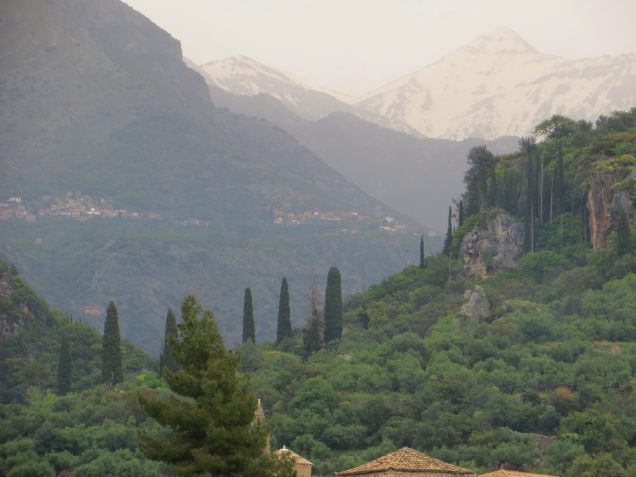
To make up for this, our next stop is only 8km away … The road went up and over the spine of the Peloponnese, mostly in very good condition and drivers who were very considerate of our bumbling progress. The air was quite thick with smoke – this is obviously burning season, and even the snow capped peaks in the near distance took on a very brownish hue. The van is just caked – it seemed to drizzle for 10 seconds every half hour, and that has coated the van with a thick brown goo – our lovely skylight is now a washed brown curtain. Hope our next campsite has a hose?
Mount Taygetus 2407m
The walk through Kardamili was lovely. This was the major harbour for Sparta in ancient times, and is mentioned in Homer’s Iliad as one of 7 cities that were offered to Achilles by Agememnon as dowry to marry one of his daughters. The Old Town also has Venetian fortifications from the 17th C, although not in a great state of repair, but with an interesting mix of Venetian, Byzantine and Greek architecture.
The town now seems to be on the up, with numerous new residential and tourist accommodations being built, occasionally even tastefully done. Tomorrow off to another Kalogria beach – caused havoc when Niki first put in our coordinates a week ago, but now much easier to find as it’s just around the headland. Weather is set to improve (marginally), and I’m working myself up to getting the wetsuit on and doing some snorkelling… time and temperature will tell.
We travelled all of 40km from Methoni to Koroni yesterday, alnong a very winding, but mercifully empty, road that took us over the spines from the westernmost finger of the Peloponnese to the next large bay.
This slideshow requires JavaScript.
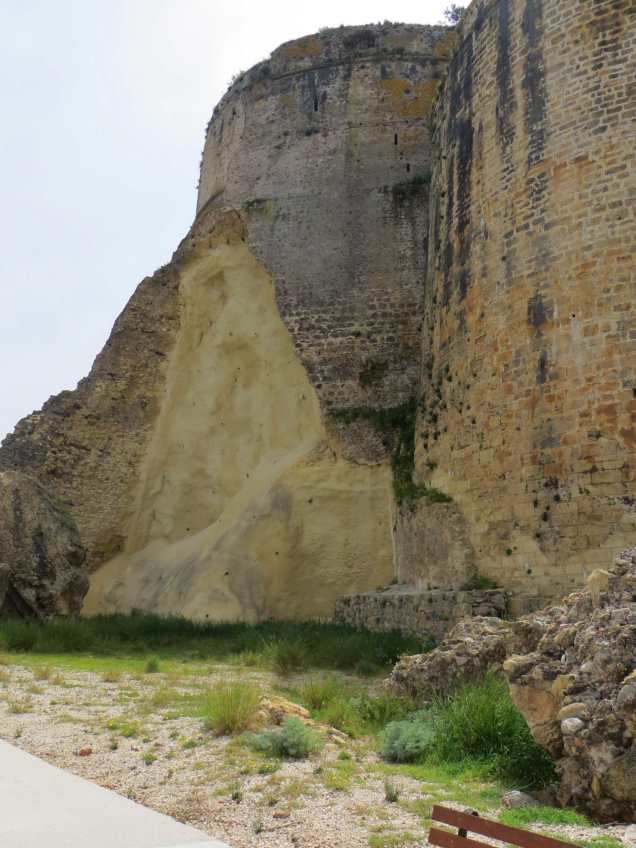
That took us to the ancient town (well, they’re all ancient, no?) of Koroni. It too has a marvellous Venetian fortress overlooking the town, which, unfortunately, is in poor state of repair. Again, just really impressive the way the walls and towers rise from sea level, but a bit saddened to see so much of the curtain wall collapsed, and significant damage to the main walled structure itself.
Venetian fortress, Koroni
The town was pretty much what we had been anticipating for small villages along the coast, but perhaps in better repair and with a sense of more money spent on infrastructure than I had anticipated. Narrow streets paralleled the quay but seemed more optimistic than similar towns in Italy. Perhaps that’s what it means to be Greek?
This slideshow requires JavaScript.
Out for dinner at a very Greek restaurant (ie catering for Greeks rather than on the harbour catering for visitors): €2.50 for half litre of wine, €5 for delicious stuffed tomatoes and green pepper, €8.50 for lamb shanks – I think that, even with our €450 ferry costs we’ll still be looking good in this month’s budget. We’ve also filled our fridge with essentials from the supermarket, such as 5 litres of white wine (€10!! Sorry New Zealand, but it don’t got to be boutique Chardonnay all the time!), 1kg of home made olives (€5), and, today, a pile of strawberries for… yes, you guessed right, €5.
Dinner, €5 s’berries
Our international sugar collection
Today’s drive of 45km was a little more challenging and took over an hour, even though I managed to hit 60km/h on the two straight sections. Driving through towns can be a little stressful. There are not many towns where the main street actually allows two cars to pass each other. To add to that, I’m constantly met by cars who insist on scrambling towards me, then stopping dead in the street unable to decide how to now scrape by. I have become the most courteous driver in Greece, happily pulling into parking bays to allow oncoming traffic to squeeze by – but you can end up parked all day if you don’t venture down the road yourself!
Camping at Koroni was a little … rustic. Our need to empty our toilet cassette means two nights free camping followed by a night in a campsite, pretty much determined by the complete absence of dumping facilities along the coast, and I couldn’t be bothered sneaking our cassette into public toilets or gas station toilets. If you can bear with me, please explain how this toilet designer was allowed near pen and paper: Imagine looking at the toilet bowl from the front towards the back. Like a medieval castle’s glacis the porcelain slopes from the top under the water cistern, towards the front of the bowl, in the process passing directly underneath your bottom. The waste pipe is located right at the front of the toilet ie towards your knees should you be seated. If you’ve imagined this correctly, you would have a grimace about now as you imagine where your deposits now land. Add to that a trickle of water dripping out of calcified pipes and the result is, clearly, a mess. I may well start a separate page on toilets because, for all the horror they can generate, they really are needed.
Koroni also seems to be the country’s cat capital – never seen so many cats in one town, slinking about and begging for scraps. Again I’m a little sorry that the numerous red tailed hawks seem reluctant to take a chance on a feline feed. This fellow seemed comfortable.
Tonight we are camped just up from the beach. Weather is a little grim – breeze blowing, overcast, and the mountains just to the North-East are still snow-covered. Campers just across the narrow hump-backed bridge from us who have been coming this way for 30 years are complaining this is the coldest April they’ve ever had. Hmmm – will get better sometime.
We continue to make breakneck progress down the west Peloponnese coast, doing 11km today and 8km yesterday. At this rate we’ll be taking out Greek citizenship before we leave. And why would that be a bad thing?
We are still in the vicinity of Navarino Bay, site of an important victory for the Greeks in their War of Independence against the Turks in 1827. The battle itself must surely count as one of the most lop-sided in history, with the combined Allied fleet suffering 700 dead and wounded, 0 ships lost; Turko-Egyptian, 4,000 dead and wounded, 60 ships destroyed. It was the last great engagement of wooden ships of war.
The area is redolent with history. We spent the better part of the day at the fortress in Methoni. This was an unexpected WOW! We were up early this morning and on our bicycles by 9:00am, really enjoying the 11km ride from Pylos to Methoni. A pre-intellectual cup of coffee was enjoyed along the town’s main road, offering us plenty of oohaaah moments as we watched traffic negotiate, in both directions, a single lane road with cars parked on both sides. From the comfort of my coffee table I still generated nervous sweat rings!
Niki carefully coordinated her colour schemes with local coffee shops
The castle is huge at around 93 acres, and I’d much rather use the term fortress. It encompassed some 800 buildings at its peak, but the purpose was always as a defensive fortification against the Turks, with defensive walls 11 metres high and 4m thick. Built in 1209 it retains the sense of magnitude and power it must have projected in the region. It fell in 1500AD, just 50 years after the fall of Constantinople. The site itself has been fortified since the 7thC BC, and was a very important trading area for the Byzantine empire, until taken over by the Venetians (1209)), lost to the Turks (1500), Venetians (1685), Turks (1715), and eventually Greeks (well, French actually, but nevertheless) in 1828.
This slideshow requires JavaScript.
We were so impressed with Methoni that we decided to move from our perfectly OK spot on the wharf at Pylos. This was made easier by Methoni having a very accessible beach, and our discovery of Modon Restaurant, where Niki’s new best friend served us the absolutely best Tzatziki and Taramasalata (fish roe salad) we’ve ever had. For €12 we had a homemade lemonade, homemade Tarama and Tzatziki, loads of great bread and a large beer – we left full.
Before settling on Taramasalata
Niki foraging …
So, a great day in Pylos, which is just stunningly beautiful, followed by a stunning day (and great swim) in Methoni.
This slideshow requires JavaScript.
If the weather plays along we might spend two nights here, catch up with some beach bats and suntan – tough, tough life! Greece is really turning out to be just as everyone said: Beautiful scenery, amazingly friendly and generous people … and some challenging roads. Oh – and to think that we are currently less than 1° from being at the furtherest point south of the entire mainland Europe!!
It’s been a lazy few days as we move down the coast. Today we are in the little town of Gialova, just across from our next destination at Pylos. And today, Ta-Dah, first swim of the European summer! If you know Niki you’ll know her virulent opposition to cold water. Hence the wetsuit top. Nevertheless, thoroughly enjoyed the swim on a sun-swept beach, hardly a breeze, but with a thunderstorm building over the mountains behind us, with a near constant roll of thunder.
I float better now there’s more surface area
Niki – not so sure
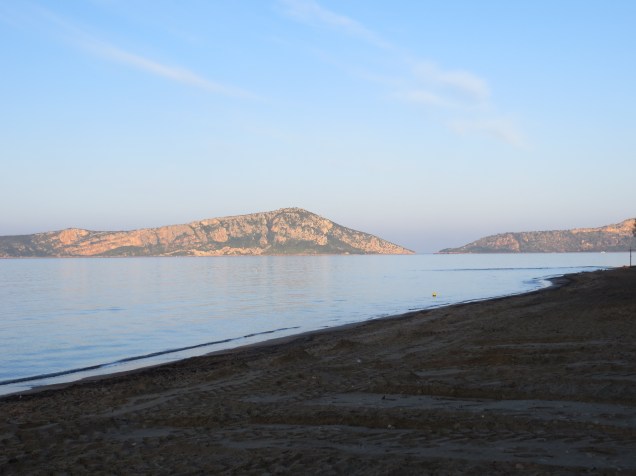
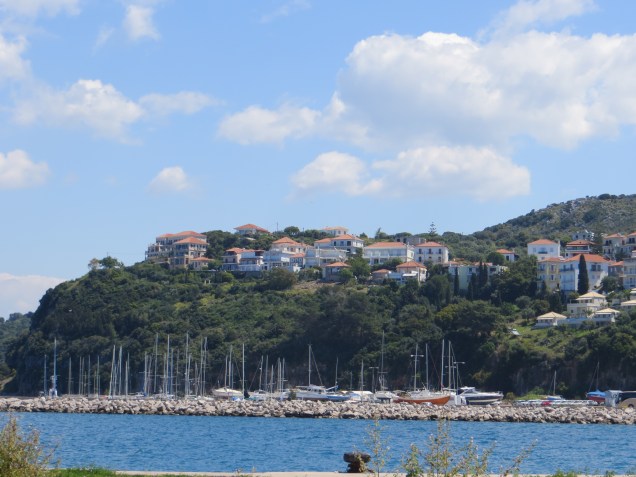
We are at the Erodios Campsite, a little luxury afforded as this is our first paid campsite in 10 days, and necessitated, in part, by our need to get some washing done. We are spending two nights here as the campsite is great and we have a section 2 meters from the beach. The view from the van is simply stunning: Headlands sweep round both right and left, aquamarine waters, islands in the bay, and the town of Pylos to the left, spreading up from the small harbour.
This slideshow requires JavaScript.
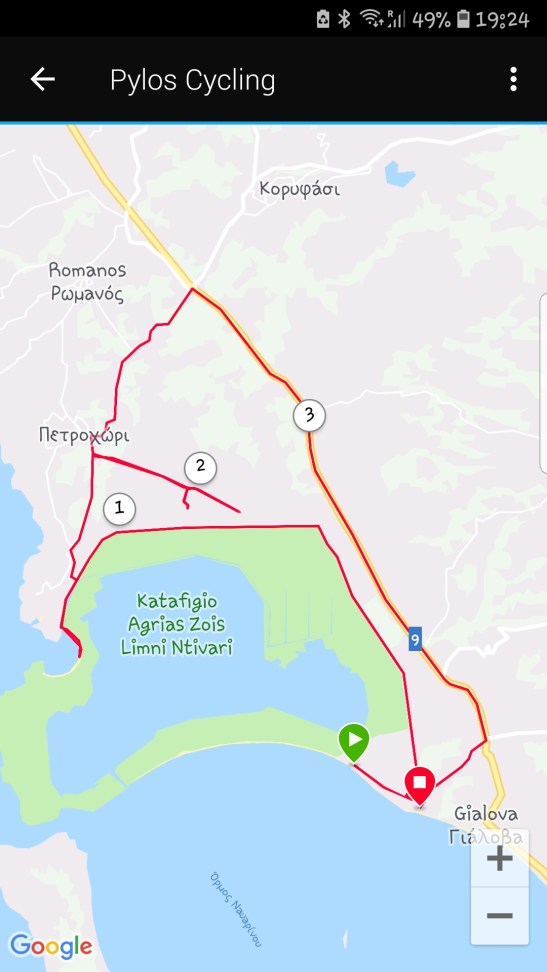
We took the bikes out yesterday and cycled along a good gravel road, sea to the left, marshlands and lakes to the right, to arrive at a stunning headland. Not content with our short cycle we headed around the lakes to what has been described as Greece’s most beautiful beach. Wow!
This slideshow requires JavaScript.
The road there went from good gravel to rutted gravel to no gravel to farmtrack to deply gouged mud track … You get the picture. I captured this on film, with Niki coming off her bike as the front wheel sticks in mud at the bottom of a deep rut. Unfortunately, due the the language it contains and the fact that Niki teaches young children, I’m not going to post it – but boy, is it worth a laugh! So, with mud spread all over Niki’s neatest shorts we arrived at the beach. On the way home we decided to avoid our original track and proceed on tar, before heading across to the campsite along another track. Bad move, as it turned out that the track simply disappeared into the marsh. Backtracked, took another route, same result, backtracked … Eventually back home before sundown to enjoy an unlimited hot water shower and more wine.
And the road deteriorates …Niki’s cycle route …
The last few days we’ve been in the company of two very nice German couples, sharing campsites as we migrate down the Peloponnese. It’s been very stress-free as everyone has met in the afternoon, having shared GPS coordinates earlier in the day – Thanks Niki. It has provided a bit of security, but now we are back on our own as everyone has set off according to their own timeframes and agendas.
This slideshow requires JavaScript.
We are definitely not going to rush down the coast but it probably means fewer posts over the next few weeks …
It’s been a gentle few days travelling down the coast, making all of 85km in 5 days. This may well set the tone for our trip around the Peloponnese. I think that, if the weather improves, we may slow down even further. Woke to the clattering of hail this morning around 4:00am – if rain sounds heavy on our fiberglass roof, then you can imagine that hail is so deafening as to make conversation impossible.
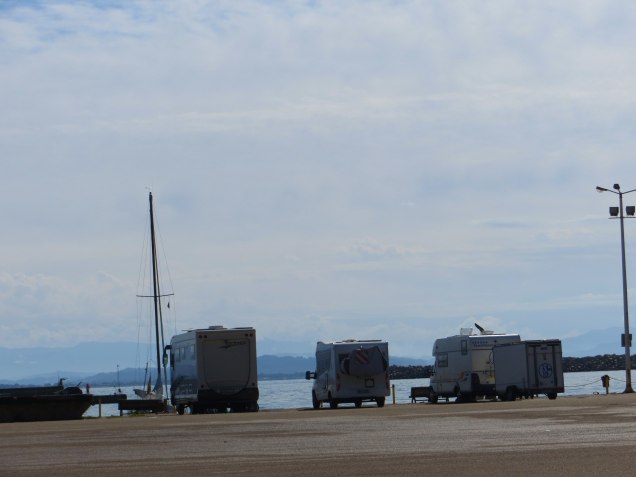
We are currently parked on the wharf in the tiny town of Katakolo, closed until the cruise ship arrives on Monday. The town is clearly geared for this, with 3 ATM machines right next to each other (versus the one per town so far) and prices at the one open tavern just really expensive. What are we using for comparison? Well, yesterday we were at Olympia …
Our little van, KatakoloKatakolo railway station
We were up in time to see that the train from Katakolo to Olympia was, as advertised, running, with departure times at 8:40 and 10:30. The 8:30 train departed pretty much on time (at 8:40), and having written down the schedule the day before, we took our time having breakfast, duly arriving at the station at 10:20. Waited until 10:45, gave up, jumped in the van and drove the 35km to Olympia, which was really easy in any case.
I’ve been warned that Olympia is a little underwhelming, and, for the ruins itself, this may be true. We, however, began with the museum, which is just SPECTACULAR! They boast the largest collection of items of war in Greece, as well as thousands of items that are quite breathtaking in their craftmanship and variety.
This slideshow requires JavaScript.
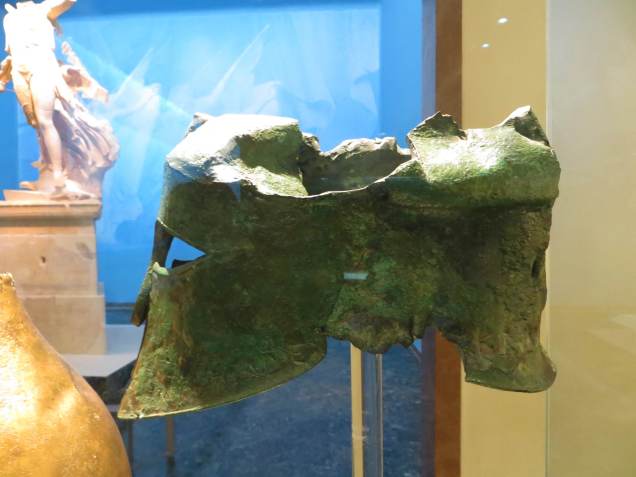
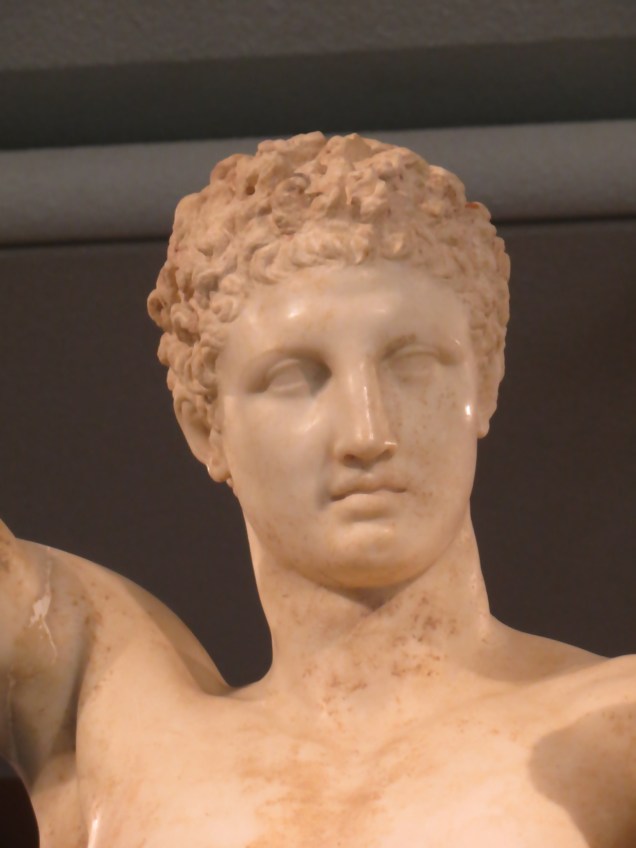
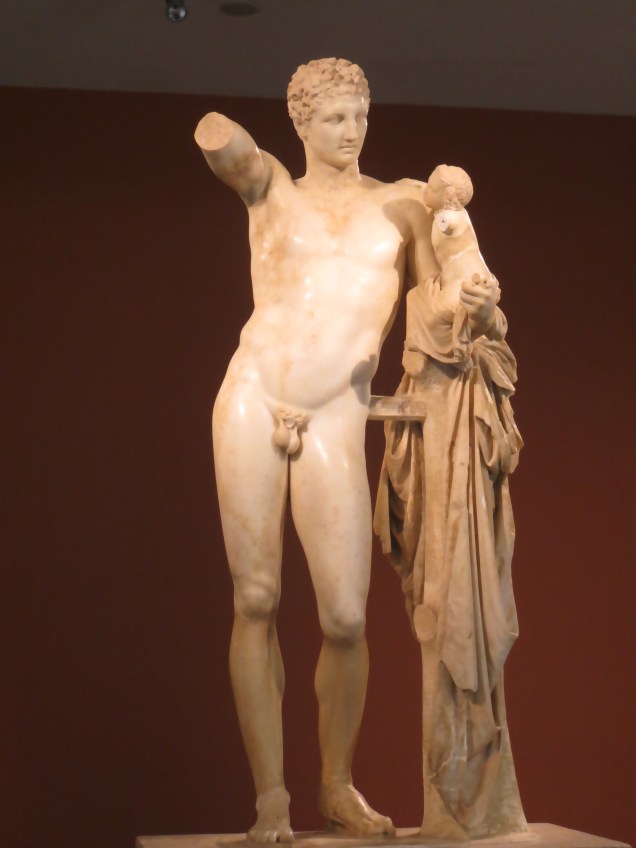
Three items stand out for me: The massive work depicting the fight of the centaurs and Lapiths, the statue of Hermes, and Militades’ helmet. An odd collection that bears some explanation.
The sculpture of the Lapiths, a Greek tribe, destroying the Centaurs after the latter, drunk at a wedding feast, had abducted Lapith women, is astonishing. The scale of the sculpture also gives an impression of what the Temple of Zeus must have looked like, as well as its impressive size. The figures, the emotions portrayed – how this is captured in stone is just remarkable.
In ‘Gates of Fire’ by Steven Pressfield – a superb read of the battle of Thermopylae, There is a quite heartrending scene when Aristodemos is sent home by the Spartans, blinded by an eye infection. Reviled as a coward Aristidemos redeems himself years later at the decisive battle of Marathon against the invading Persians by charging, alone, at an army reputed to be almost 2 million strong. Interestingly enough, he was awarded no honours as his suicidical charge was contradictory to the Spartan battle plan of a cohesive phalanx. In any case, this is Militades’ helmet, an offering at Olympia following the decisive Greek victory at Marathon. Seriously, how cool is that?
Hermes carries the infant god Dionysus, a superb (the best?) surviving statue of the 4thC BC, with most known works from this time known as a result of their Roman copies. The statue is so fine, the features unblemished, The musculature brings the statue to life and the display, understated, really does allow the focus to remain on the 2.1m high statue.
Backtracking a little: After arriving in Patras we drove 20km down the coast to a bar at the beach, spending one night as we just wanted to get our feet under us again. The next day a short (30km) drive took us to the beach at Kalogria, spending 2 nights at a huge carpark (and almost no people), right on the beach. The area is a national park, and we took the opportunity to cycle the park, accompanied by a volume of croaking frogs that was, in some places, load enough that we had to really raise our voices in conversation. This also brought us to an ancient fortified town of Teichos Dymaion, with original fortifications from 1300 B.C, and inhabited until 1700 A.D.
This slideshow requires JavaScript.
We’ve also fallen in with a German couple, Kallie and Erika, who have, in the nicest way, asked if they could tag along for security until we are past Methoni – there have been a number of incidents of vans being broken into or harassed. It’s sort of like travelling with Niki’s folks. We share our co-ordinates for the coming night’s stop, meet up there and then, perhaps, join for a walk or gentle cycle. This has worked well, and we also appreciate the sense of security this offers – not that we’ve had any issues so far.
This slideshow requires JavaScript.
I’m asking Niki to do some research on the museum to jog my memory – she’s come back with: ‘Oh, Easter is coming and the traditional meal is roasted whole lamb with tzatziki and olives accompanied by roasted potatoes and spinach & cheese pie.’ Well, Greece may yet prove to be something for everyone!






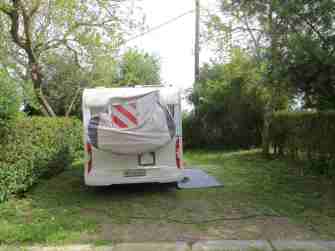 Camping at Koroni was a little … rustic. Our need to empty our toilet cassette means two nights free camping followed by a night in a campsite, pretty much determined by the complete absence of dumping facilities along the coast, and I couldn’t be bothered sneaking our cassette into public toilets or gas station toilets. If you can bear with me, please explain how this toilet designer was allowed near pen and paper: Imagine looking at the toilet bowl from the front towards the back. Like a medieval castle’s glacis the porcelain slopes from the top under the water cistern, towards the front of the bowl, in the process passing directly underneath your bottom. The waste pipe is located right at the front of the toilet ie towards your knees should you be seated. If you’ve imagined this correctly, you would have a grimace about now as you imagine where your deposits now land. Add to that a trickle of water dripping out of calcified pipes and the result is, clearly, a mess. I may well start a separate page on toilets because, for all the horror they can generate, they really are needed.
 Koroni also seems to be the country’s cat capital – never seen so many cats in one town, slinking about and begging for scraps. Again I’m a little sorry that the numerous red tailed hawks seem reluctant to take a chance on a feline feed. This fellow seemed comfortable.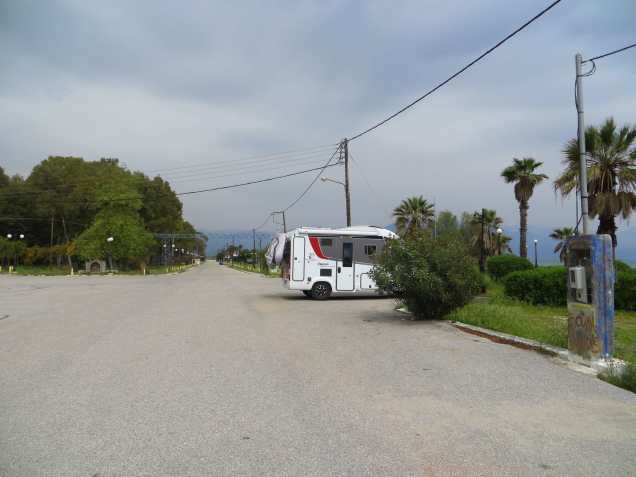




 Contented-Campers.com